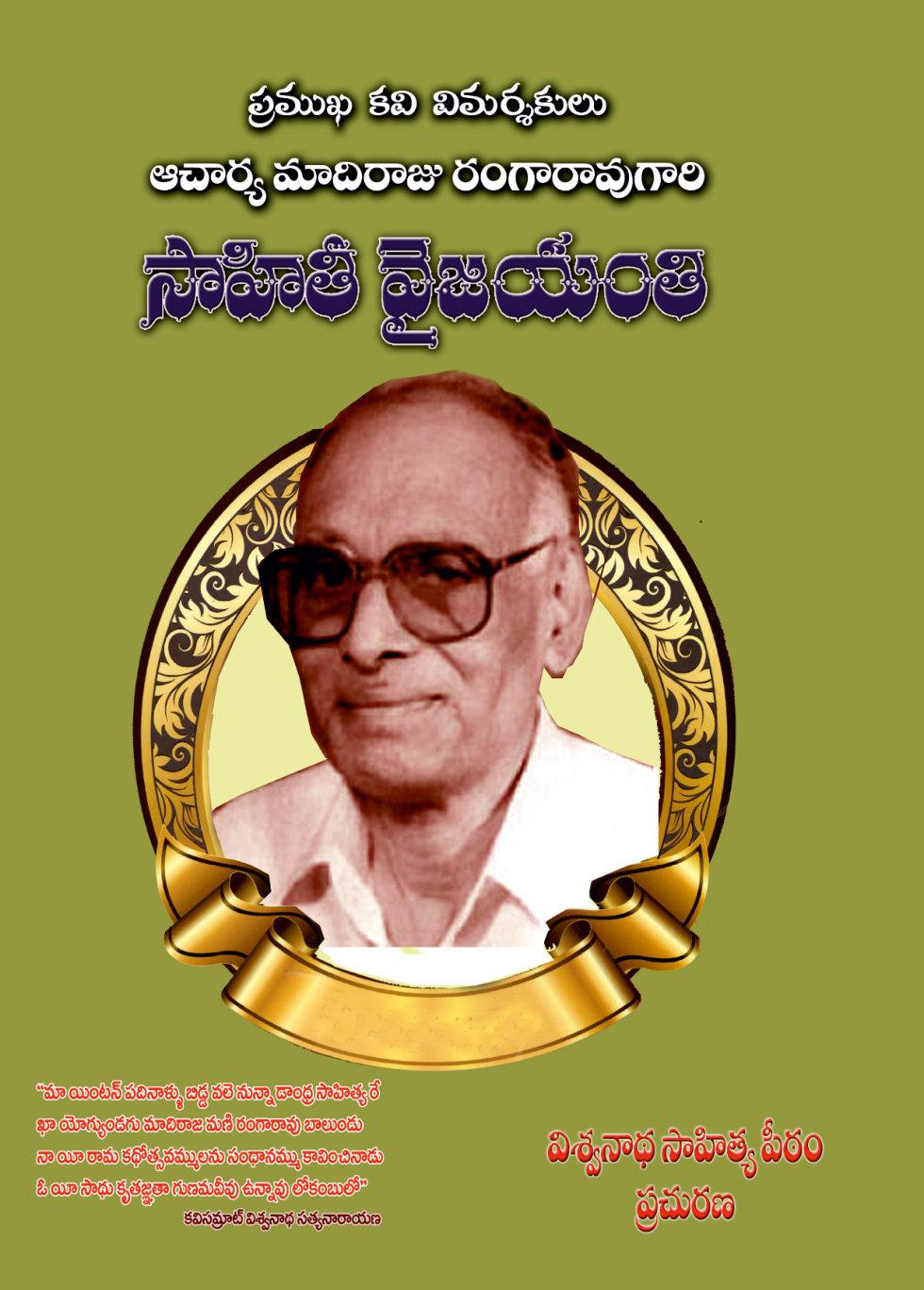
Book
గ్రంథాల ఆవిష్కరణ సభ
July 11, 2026 — Residency Hall, Hotel Green Park, Greenlands, Begumpet, Hyderabad
Book
The book released at this event.
Book
Video
The primary recording from this event.
Photo Gallery
Showing 24 of 355
Press Coverage
Praja Paksham
Praja Paksham • July 7, 2026
Full newspaper edition of Praja Paksham (July 7, 2026) featuring the announcement for the upcoming July 11, 2026 book launch ceremony.
Article
Telangana Reuters
Telangana Reuters • July 12, 2026
Telangana Reuters reports on the first death anniversary sabha at Hotel Green Park, where Justice L. Narasimha Reddy unveiled the poet's collections of free verse and literary criticism, and speakers noted that Ranga Rao's writings embody humane values that should guide coming generations.
Article
Nijam Today
Nijam Today • July 12, 2026
Nijam Today's report on the book release, noting that Ranga Rao's writings embody the humane values a society needs, and that his free verse and criticism blended classical tradition with a modern outlook while addressing social concerns.
Article
Trikala Telugu
Trikala Telugu • July 12, 2026
Trikala Telugu's coverage of the first death anniversary sabha, at which Justice L. Narasimha Reddy released Swecchaa Kavitvam (11 volumes), Sahitya Vimarsa (2 volumes) and Sahithi Vaijayanthi, and speakers praised the humaneness of Ranga Rao's poetry.
Telugu television news coverage of the July 11, 2026 programme at Residency Hall, Hotel Green Park, Greenlands, Begumpet, Hyderabad.
Selected Event Details
The program features the release of 'Sahithi Vaijayanthi' (a Viswanatha Sahitya Peetham publication), the 11-volume 'Swecchaa Kavitvamu' collection, and the 2-volume 'Sahitya Vimarsa' critical works.
Distinguished jurists, writers, and literary critics will gather to discuss the immense contribution of Acharya Madiraju Ranga Rao to Telugu literature.
Date
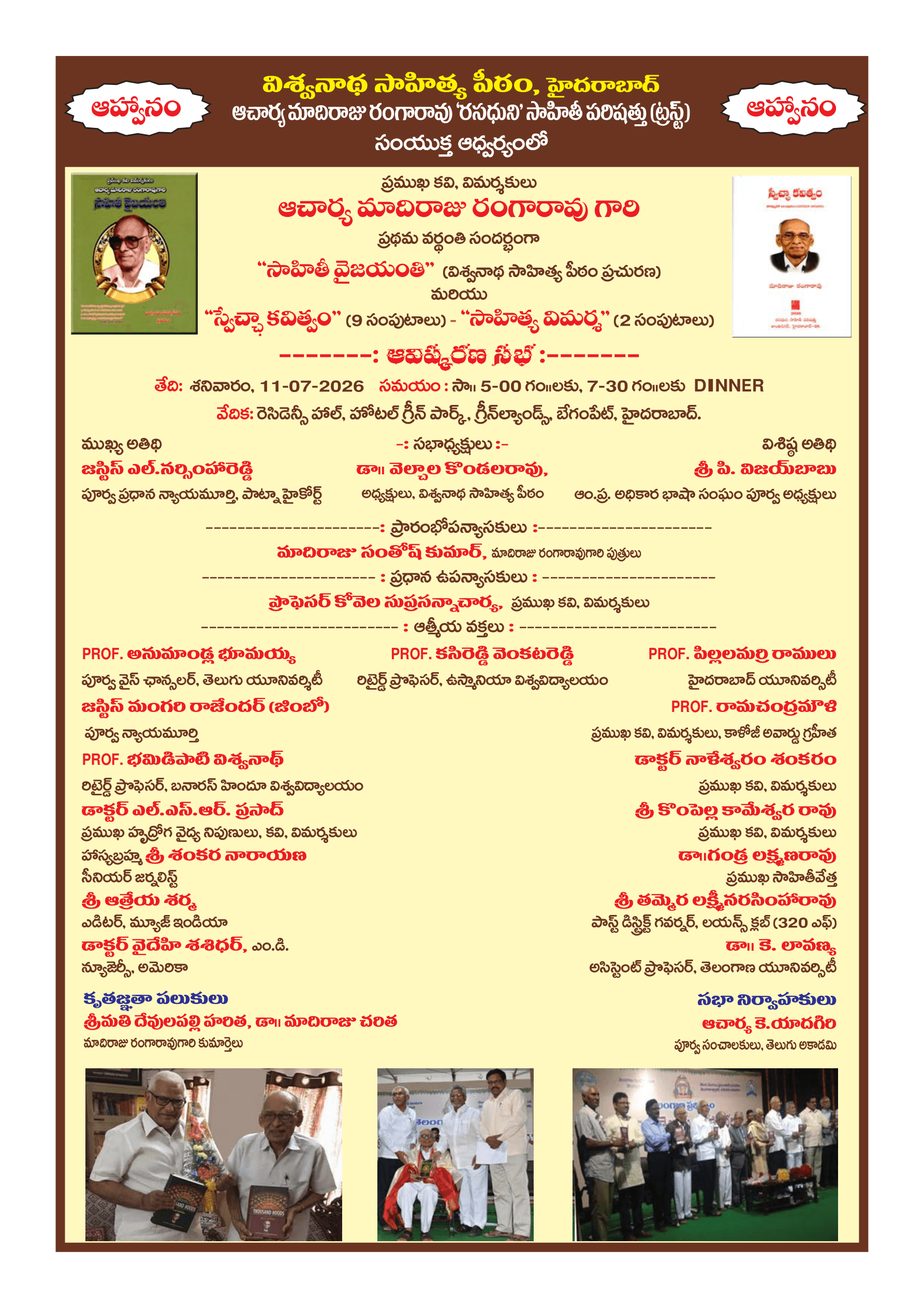
July 11, 2026
Venue
Residency Hall, Hotel Green Park, Greenlands, Begumpet, Hyderabad
Organizer
Viswanatha Sahitya Peetham & Acharya Madiraju Ranga Rao 'Rasaduni' Sahithi Parishath (Trust)
Event
Grantha Āviṣkaraṇa
Sabha Report
First Vardhanti · Book Release
Hotel Green Park, Begumpet, Hyderabad · Saturday, July 11, 2026
Live Reporting
A. Raja Hussain
On Saturday evening, under the joint auspices of Viswanatha Peetham, Hyderabad and the Acharya Madiraju Ranga Rao 'Rasaduni' Sahithi Parishath, a grand assembly was held at Hotel Green Park, Begumpet, to mark the first death anniversary of the eminent poet and critic Acharya Madiraju Ranga Rao. The gathering marked the release of 'Sahithi Vaijayanthi', along with Swecchaa Kavitvam (11 volumes) and Sahitya Vimarsa (2 volumes). Madiraju Ranga Rao's books were formally unveiled at the sabha.
Dr. Santosh Kumar
Son of Acharya Madiraju Ranga Rao · Inaugural Address
Delivering the inaugural address, he announced the establishment of the 'Acharya Madiraju Ranga Rao Rasaduni Sahithi Peetham' in his father's name.
He said that every year, on behalf of this Peetham, awards would be conferred upon litterateurs and poets. He further announced that literary programmes would also be organised for students.
Velchala Kondala Rao
President, Viswanatha Sahitya Peetham · Presiding over the Sabha
Presiding over the assembly, he expounded on Madiraju Ranga Rao's Swecchaa Kavitvam and brought his towering personality vividly before the audience's eyes.
Every poet writes for the sake of a moral vision, and adopts a manner in which to write it. What, then, was Ranga Rao's moral vision? As far as I understand it, it was principally humanity. Everyone writes for the sake of humane values — Ranga Rao wrote for their nurture and their betterment, he said.
In all the books Ranga Rao composed, it is these that he chiefly addresses. In one sense, if all these writings are taken together, they become a history of humaneness itself. He wrote that history not as others had written it, but in an entirely new way. It is a history useful to everyone, to all countries and to all ages; in that manner he gave a single name to all the histories of the past. That is, in a sense, an invention and an innovation — to give history another name. And in that, Ranga Rao was the pioneer.
The Swecchaa Kavitvam he wrote is called Verse Libre, Prose Poetry and Blank Verse in English. There are many ways of writing poetry. The poetry of earlier times belonged largely to slokas, padyas, songs and geyas — and for all of these, countless rules and regulations were prescribed. That is why he was an 'inventor' and an 'innovator'; he thought about everything anew, ever anew, he said.
As far as I have read, there are many new words and phrases in Ranga Rao's language — all of them his own creations. If you ask me, his language is his alone, he said. Likewise his thought too is remarkable, because it belongs to the philosophical, visionary and spiritual order.
Acharya K. Yadagiri
Chief Organizer of the Sabha
Justice L. Narasimha Reddy
Chief Guest · Former Chief Justice
He said that writing so many books was something only Ranga Rao could have accomplished. That he could offer criticism on all subjects and on the poetry of all poets was a great thing, he said. He added that his literature also contains an analysis of the human being.
Kovela Suprasannacharya
Eminent Poet and Critic
Speaking about Madiraju's Swecchaa Kavitvam, he said this is a new age — an age of freedom and equality. With a democratic and socialist vision, freedom flourishes ever more newly as time passes. This is not vachana kavitvam; what he has been writing for seventy years was established under this name — 'Swecchaa Kavitvam', he said.
He said Ranga Rao took the elements of nature as symbols and wrote his free verse, and that he wrote poetry remarkable both in quantity and in quality. Rather than writing padyas, he chose another new path and named it Swecchaa Kavitvam, he said.
Justice Mangari Rajender (Jimbo)
Former Judge · Writer
He said it was a matter of sorrow and of lasting want that he could not meet Madiraju during his lifetime. Ranga Rao, paying no heed to himself, went on doing his own work like a rishi, he said.
Poetry is a Pushpaka Vimana — however many poets may come, there is room for them in the world of poetry, he used to say. Even when critics paid him no attention, Ranga Rao went on doing his own work, he said.
Anumandla Bhumayya
Disciple of Madiraju Ranga Rao
Speaking on the occasion, he said that Madiraju's teaching of criticism was magnificent. When Ranga Rao taught a lesson in the classroom, the students would be transported into rapture, he said.
He noted that the Telangana Swaram Ranga Rao wrote has been translated into English. He was not one to toss off a padya casually — he would sing it beautifully and melodiously, he said. Looking at the collected literature published now, Madiraju appears to us as ever-youthful, he said.
P. Vijaya Babu
Journalist
He introduced the writings of Acharya Madiraju Ranga Rao, saying that to bring out 170 books as a poet and a writer is no small matter.
The manner in which Ranga Rao offered criticism on Viswanatha's Ramayana Kalpavruksham was unprecedented and unrepeatable, he said. Ranga Rao was a litterateur who blended the ancient and the modern, he said, adding that the printing of his books should be expanded further.
Hasyabrahma Shankaranarayana
Humorist
He said Madiraju Ranga Rao was neither an extremist nor a moderate — he was a well-wisher (hitavaadi). The humaneness in Madiraju Ranga Rao's poetry is a great thing, he said.
Dr. Elchuri Muralidhar Rao
Scholar
He said that the son and daughters who have printed Madiraju's books have repaid their debt to their father.
Acharya Kasireddy Venkat Reddy
Litterateur
He said that Madiraju Ranga Rao's poetry is universal, and spoke of the closeness he shared with Ranga Rao.
Others who spoke on the distinction of Ranga Rao's literature
From beginning to end, the sabha was fragrant with the literature of Madiraju Ranga Rao.
The assembly was conducted ably by Acharya K. Yadagiri.
Videos
The full recording of the sabha at which Madiraju Ranga Rao's complete literary collections were unveiled — a remarkable gathering joined by the towering figures of the Telugu literary world.
Documents
Official printable PDF invitation for the July 11, 2026 ceremony.
Open DocumentInvitation
Related Events
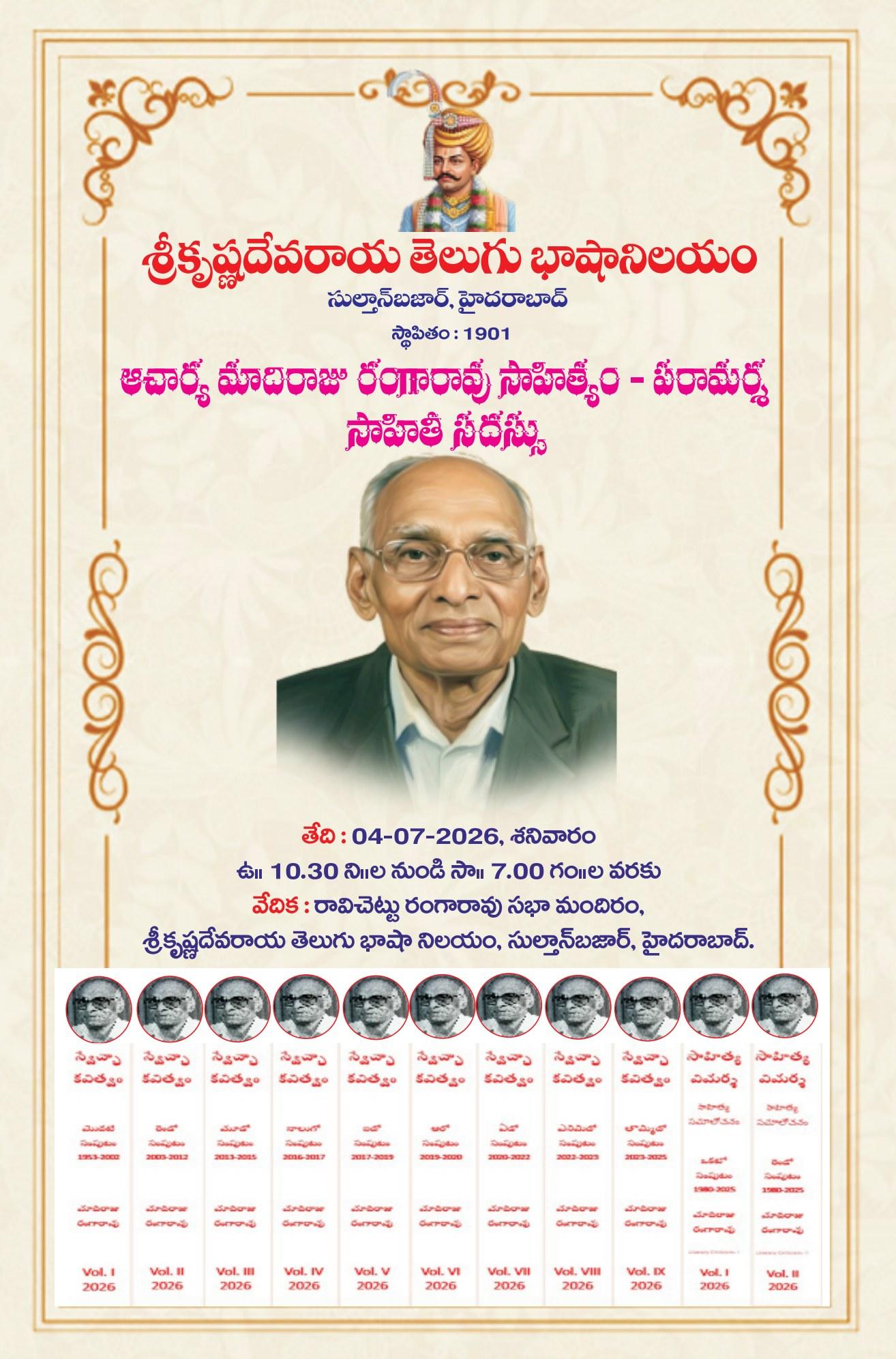
July 4, 2026
A central archive entry for the July 4, 2026 Sahitya Parāmarśa symposium dedicated to the works of Prof. Madiraju Ranga Rao, including invitations, programme details, and future media additions.
Open This Event